
Product Categories
For purchase and inquiry
- 38-C Postogola DIT Plot, I/A Shyampur, Dhaka-1204
- 01720004147
- asianpetroltd@gmail.com
Loading

Lubricants & Chemicals Importers, Exporters, Manufacturers & Suppliers

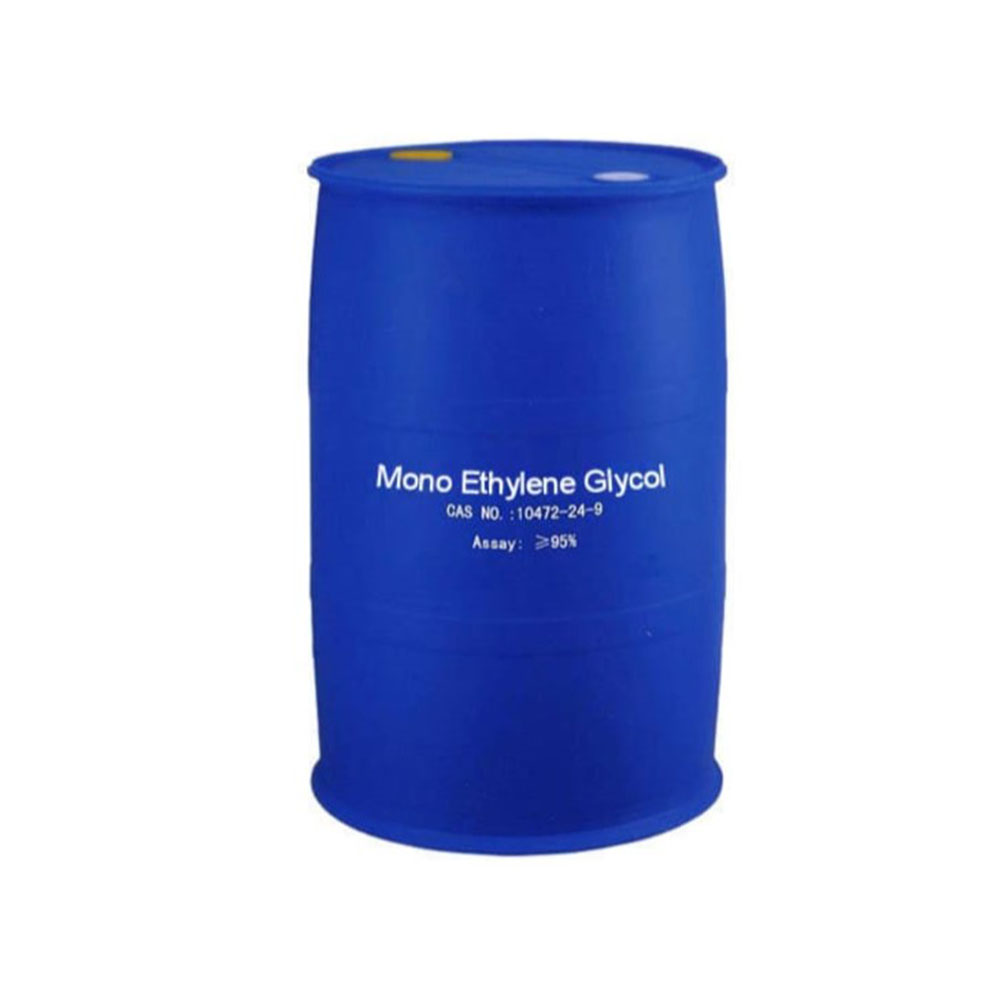
Ethylene glycol (IUPAC name: ethane-1,2-diol) is an organic compound (a vicinal diol[7]) with the formula (CH2OH)2. It is mainly used for two purposes: as a raw material in the manufacture of polyester fibers and for antifreeze formulations. It is an odorless, colorless, flammable, viscous liquid. It has a sweet taste, but is toxic in high concentrations. This molecule has been observed in outer space.
Production
Industrial routes
Ethylene glycol is produced from ethylene (ethene), via the intermediate ethylene oxide. Ethylene oxide reacts with water to produce ethylene glycol according to the chemical
equation:
C2H4O + H2O → HO−CH2CH2−OH
This reaction can be catalyzed by either acids or bases, or can occur at neutral pH under elevated temperatures. The highest yields of ethylene glycol occur at acidic or neutral pH with a large excess of water. Under these conditions, ethylene glycol yields of 90% can be achieved. The major byproducts are the oligomers diethylene glycol, triethylene glycol, and tetraethylene glycol. The separation of these oligomers and water is energy-intensive. World production of ethylene glycol was ~20 Mt in 2010.[9]
Ethylene glycol is produced from carbon monoxide in countries with large coal reserves and less stringent environmental regulations. The oxidative carbonylation of methanol to dimethyl oxalate provides a promising approach to the production of C
1-based ethylene glycol.[11] Dimethyl oxalate can be converted into ethylene glycol in high yields (94.7%)[12] by hydrogenation with a copper catalyst:[13]
Because the methanol is recycled, only carbon monoxide, hydrogen, and oxygen are consumed. One plant with a production capacity of 200 000 tons of ethylene glycol per year is in Inner Mongolia, and a second plant in the Chinese province of Henan with a capacity of 250 000 tons per year was scheduled for 2012.[14] As of 2015, four plants in China with a capacity of 200 000 t/a each were operating with at least 17 more to follow.[15]
Biological routes
Ethylene glycol can be produced by recycling its polymeric derivatives such a polyethylene terephthalate.[16]
Historical routes
According to most sources, French chemist Charles-Adolphe Wurtz (1817–1884) first prepared ethylene glycol in 1856.[17] He first treated "ethylene iodide" (C2H4I2) with silver acetate and then hydrolyzed the resultant "ethylene diacetate" with potassium hydroxide. Wurtz named his new compound "glycol" because it shared qualities with both ethyl alcohol (with one hydroxyl group) and glycerin (with three hydroxyl groups). In the United States, semicommercial production of ethylene glycol via ethylene chlorohydrin started in 1917. The first large-scale commercial glycol plant was erected in 1925 at South Charleston, West Virginia, by Carbide and Carbon Chemicals Co. (now Union Carbide Corp.). By 1929, ethylene glycol was being used by almost all dynamite manufacturers. In 1937, Carbide started up the first plant based on Lefort's process for vapor-phase oxidation of ethylene to ethylene oxide.
Uses
Coolant and heat-transfer agent
The major use of ethylene glycol is as an antifreeze agent in the coolant in for example, automobiles and air-conditioning systems that either place the chiller or air handlers outside or must cool below the freezing temperature of water.
Pure ethylene glycol has a specific heat capacity about one half that of water. So, while providing freeze protection and an increased boiling point, ethylene glycol lowers the specific heat capacity of water mixtures relative to pure water. A 1:1 mix by mass has a specific heat capacity of about 3140 J/(kg•°C) (0.75 BTU/(lb•°F)), three quarters that of pure water, thus requiring increased flow rates in same-system comparisons with water.
The mixture of ethylene glycol with water provides additional benefits to coolant and antifreeze solutions, such as preventing corrosion and acid degradation, as well as inhibiting.Mixtures of ethylene glycol and water are sometimes informally referred to in industry as glycol concentrates, compounds, mixtures, or solutions.